




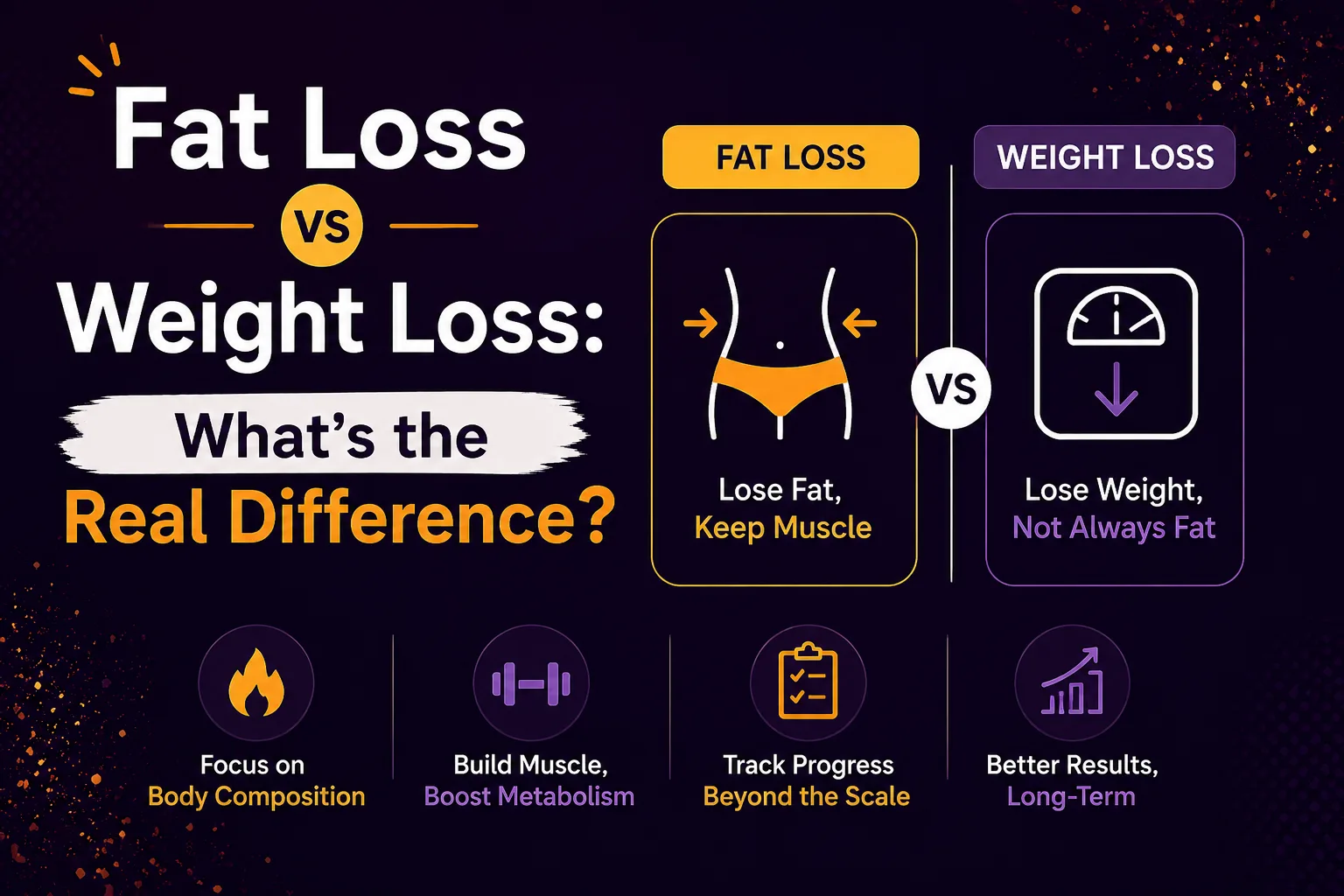
Fat Loss vs Weight Loss: What’s the Real Difference?
A lot of people say they want to lose weight, but what they often mean is that they want to look leaner, feel stronger, and lose body fat.
That is where the confusion starts.
The scale can go down without body composition improving much. At the same time, body fat can go down even when scale weight barely changes. Weight loss and fat loss are related, but they are not the same thing.
Weight loss means your total body weight decreases. Fat loss means your body fat decreases more specifically. For many people, fat loss is the more useful goal because it focuses on body composition, strength, and long-term progress instead of only chasing a lower number on the scale.
SlimAI Calorie Tracker is an AI-powered food logging and weight-management app that helps users track calories, macros, workouts, water, fasting, steps, and progress in one connected routine. SlimAI is built for people who want nutrition clarity without making food tracking feel stricter.
What Is the Difference Between Fat Loss and Weight Loss?
Weight loss is a broad change in body weight. Fat loss is a more specific change in body fat.
When the scale drops, that change can come from several things:
- body fat
- water
- glycogen
- food volume in the digestive system
- muscle or lean mass
That is why a sudden drop on the scale does not always mean you lost a lot of fat. It may reflect water changes, reduced carbohydrate storage, digestion, or changes in training and sodium intake.
Fat loss is different because it focuses on reducing stored body fat. This is usually what people mean when they want to look leaner, improve body composition, or feel more confident in how their body looks and performs.
The scale can be useful, but it is not the full story.
Are Weight Loss and Fat Loss the Same?
No. Weight loss and fat loss are not the same.
Weight loss tells you that total body mass has decreased. Fat loss tells you that body fat has decreased. A person can lose weight quickly without improving body composition much, especially if the loss includes water and muscle. Another person can lose fat while the scale changes slowly because they are retaining muscle or experiencing normal water fluctuations.
This is why “losing weight” is not always the best goal by itself. A better question is: what kind of weight are you losing?
If the goal is long-term health, strength, and body composition, fat loss is usually more useful to track than scale weight alone.
What Counts as Weight Loss?
Weight loss includes any reduction in total body mass.
This means the number on the scale may change because of fat loss, water loss, lower glycogen, less food volume, or lean mass change. That is why people sometimes see fast scale movement in the first week of a new diet, even when body fat has not changed dramatically yet.
For example, reducing calories or carbohydrates may lower water and glycogen storage, which can make weight drop quickly. That does not automatically mean the body has lost the same amount of fat.
Weight loss is real, but scale weight does not explain where the loss came from.
What Counts as Fat Loss?
Fat loss means your body is reducing stored fat.
This is usually the goal when someone wants to get leaner, improve body shape, feel more athletic, or support better body composition. Fat loss can happen with scale weight loss, but the two do not always move at the same speed.
Someone doing resistance training may lose fat while holding on to more lean mass. In that case, the scale may move slowly, but clothes may fit differently, measurements may change, and strength may improve.
That is why fat loss should be judged with more than one progress marker. Scale weight is useful, but measurements, photos, workout performance, energy, and consistency also matter.
What Is Better: Weight Loss or Fat Loss?
For many people, fat loss is the better goal.
Weight loss can be useful when someone needs to reduce total body weight, but fat loss is usually more aligned with looking leaner, preserving strength, improving body composition, and building a routine that lasts.
Fast weight loss can sometimes include too much water or lean mass. Better-quality fat loss usually depends on a manageable calorie deficit, enough protein, resistance training, sleep, and consistency.
That does not mean everyone needs to obsess over body composition. It means the scale should not be the only measurement of progress.
A lower number is not always better if the process leaves you weaker, exhausted, or unable to maintain the routine.
Does a Calorie Deficit Cause Weight Loss?
A calorie deficit can support weight loss when energy intake stays below energy expenditure over time.
In simple terms, if you consistently consume fewer calories than your body uses, your body has to make up the difference. That is the basic reason calorie deficits are used for weight loss.
But the quality of that weight loss depends on more than the deficit itself.
A calorie deficit can reduce weight, but whether that loss is mostly fat depends on factors such as:
- deficit size
- protein intake
- resistance training
- daily movement
- sleep and recovery
- consistency over time
This is why “eat less” is not the full answer. The goal is not just to lose weight. The goal is to create a routine that supports better fat loss without making the process harder than it needs to be.
Is a Calorie Deficit the Only Way to Lose Weight?
In practical terms, weight loss requires an energy deficit, but people can create that deficit in different ways.
Some people reduce portion sizes. Some increase daily movement. Some improve food quality so they feel fuller with fewer calories. Others use meal planning, workout routines, or tracking tools to stay more consistent.
The method can vary, but the energy balance still matters.
For sustainable weight management, the real question is not only “am I in a calorie deficit?” It is also “can I repeat this routine without constantly restarting?”
A realistic deficit is usually more useful than an extreme one because it is easier to maintain and less likely to disrupt training, energy, or food habits.
Diet for Weight Loss vs Diet for Fat Loss
A diet for weight loss mainly focuses on reducing total calorie intake.
A diet for fat loss still needs calorie awareness, but it usually requires more attention to food quality, protein, and meal structure. Protein matters because it supports fullness and helps preserve lean mass during a calorie deficit, especially when paired with resistance training. A review in The American Journal of Clinical Nutrition found greater fat mass loss and better preservation of lean mass on higher-protein energy-restriction diets than on lower-protein ones, along with greater perceived fullness after higher-protein meals.
For weight loss, someone may focus mostly on eating fewer calories.
For fat loss, the focus becomes more balanced:
- enough protein
- a manageable calorie deficit
- meals that support fullness
- strength training support
- better recovery
- consistent tracking
This is where macro tracking becomes useful. Calories show total energy, but macros show the structure behind that energy: protein, carbohydrates, and fats.
SlimAI’s Macro Tracker helps users review protein, carbs, fats, and calories together so they can understand food beyond calorie totals.
Exercise for Weight Loss vs Exercise for Fat Loss
Exercise helps both weight loss and fat loss, but the type of exercise matters.
For weight loss, almost any increase in activity can help because movement increases energy expenditure. Walking more, doing cardio, and staying active throughout the day can support a calorie deficit.
For fat loss, resistance training becomes especially important because the goal is not only to burn calories. The goal is to reduce fat while preserving as much lean mass as possible. A systematic review and meta-analysis of 34 randomised trials found that adding training to calorie restriction retained about 0.87 kg more fat-free mass than calorie restriction alone, preventing roughly 45% of the fat-free mass loss, with the largest effect from mixed and strength training.
A better fat-loss routine often includes:
- resistance training
- enough protein
- daily movement
- a sustainable calorie deficit
- recovery and sleep
- consistent food tracking
This is why someone focused on fat loss should not rely only on the scale. Training performance, strength, body measurements, and how clothes fit can all provide useful context.
SlimAI helps users connect Workout Tracking with food logging, calorie balance, macros, and progress so food and fitness do not feel like separate routines.
Why the Scale Can Be Misleading
The scale is useful, but it can be misleading when used alone.
Body weight naturally changes because of water, sodium, glycogen, digestion, menstrual-cycle changes, training stress, and food volume. A person can do many things right and still see the scale move slowly for a few days.
The opposite can also happen. The scale can drop quickly without much true fat loss if the change is mostly water or food volume.
That is why fat loss progress should be reviewed over time, not judged by one morning weigh-in.
Better progress markers include:
- weekly weight averages
- waist or body measurements
- progress photos
- strength and workout performance
- energy levels
- consistency with meals and activity
- calorie and macro patterns
SlimAI’s Progress and Insights help users review patterns over time instead of reacting to one meal, one day, or one scale number.
What Do People Usually Get Wrong About Fat Loss vs Weight Loss?
The biggest mistake is assuming every scale drop is fat loss.
A lower weight can be encouraging, but it does not automatically mean body composition improved. If a diet is too aggressive, some of the loss may come from water and lean mass.
Another mistake is ignoring protein and strength training. If someone wants fat loss, the goal is not just to weigh less. The goal is to keep the body strong while reducing body fat.
A third mistake is restarting every time the scale fluctuates. Scale changes are normal. One higher weigh-in does not mean the routine failed.
Fat loss works better when users focus on patterns, not panic.
How SlimAI Helps You Focus on Better Fat Loss
SlimAI Calorie Tracker helps users focus on the habits that support better fat loss and weight management.
Instead of relying only on the scale, SlimAI helps users track the parts of the routine that actually shape progress:
- calories consumed, burned, and remaining
- meals across breakfast, lunch, dinner, and snacks
- Macro Tracker for protein, carbs, and fats
- Custom Calorie Goals
- Workout Tracking
- Water Tracking
- Fasting Tracking
- Step Counter Tracking
- Progress and Insights
AI calorie estimates can vary because portion size, ingredients, sauces, cooking methods, and serving size affect results. SlimAI reduces that friction with Ingredient Editing and Serving Size Guidance, so users can adjust ingredients or portions and see calories and macros update accordingly. This helps food entries stay closer to what was actually eaten.
SlimAI Premium also includes unlimited scans, Voice Logging with Speak and Get Your Recipe, Type to Log, priority access to new SlimAI features, and support from a SlimAI representative. Premium is useful for users who want faster food logging and fewer skipped logs.
The goal is not stricter tracking. The goal is clearer tracking.
Eat smarter, not stricter.
Practical Steps to Focus on Fat Loss Instead of Just Weight Loss
Start with a routine you can repeat.
1. Use a manageable calorie deficit
Avoid extreme restrictions. A smaller, consistent deficit is usually easier to maintain than an aggressive one.
2. Track protein and macros
Protein can support fullness and lean-mass preservation. Tracking macros helps you understand the quality of your calorie intake.
3. Add resistance training
Strength training helps preserve muscle while you reduce body fat. This improves the quality of weight loss.
4. Review progress weekly, not daily
Daily weight changes are noisy. Weekly trends are more useful.
5. Edit food entries when needed
For homemade meals, sauces, oils, and mixed dishes, review ingredients and serving sizes. This makes food tracking more realistic.
6. Use more than the scale
Look at measurements, photos, workout progress, energy, and consistency. Fat loss is not always visible on the scale immediately.
Common Mistakes to Avoid
Mistake 1: Chasing fast scale drops
Fast scale loss can feel exciting, but it may include water and lean mass. Focus on sustainable fat loss, not just quick weight loss.
Mistake 2: Ignoring protein
Low protein can make fat loss harder because it may affect fullness and lean-mass preservation. Track calories and protein together when body composition is the goal.
Mistake 3: Skipping strength training
Cardio can help with calorie burn, but resistance training is important for preserving muscle during fat loss.
Mistake 4: Trusting one weigh-in too much
One weigh-in does not define your progress. Look for patterns across weeks.
Mistake 5: Treating tracking as punishment
Tracking should give clarity, not guilt. A good calorie tracker helps you understand patterns and make adjustments without turning food into a moral test.
Conclusion: Fat Loss vs Weight Loss
Fat loss and weight loss are connected, but they are not the same. Weight loss means the number on the scale goes down, while fat loss means your body is specifically reducing stored body fat. For many people, fat loss is the more meaningful goal because it focuses on body composition, strength, consistency, and long-term progress instead of daily scale changes.
A calorie deficit can support weight loss, but better-quality fat loss also depends on protein intake, resistance training, recovery, and realistic habits. The scale can still be useful, but it should not be the only way you measure progress.
SlimAI Calorie Tracker helps users track calories, macros, meals, workouts, water, fasting, steps, and progress in one connected routine. With features like Custom Calorie Goals, Macro Tracker, Ingredient Editing, Serving Size Guidance, Progress, and Insights, SlimAI helps users understand their routine more clearly and focus on meaningful progress over time.