






If you have spent any time in fitness spaces online, you have probably seen people talk about “hitting macros” like it is the secret code to weight loss. But here is the short answer: tracking macros for weight loss can help, but not everyone needs to do it strictly. For many people, calorie awareness alone is enough to get started. Macro tracking becomes useful when you want more structure around hunger, energy, performance, or muscle retention.
Slim AI-Calorie Tracker helps with both by showing calories and macros in one place, so you can keep things simple or go more detailed when it actually serves your goal. Its core features include calorie tracking, macro ratios, meal logging, workout logging, photo-based meal analysis, and weekly progress.
What Does “Macro” Actually Mean?
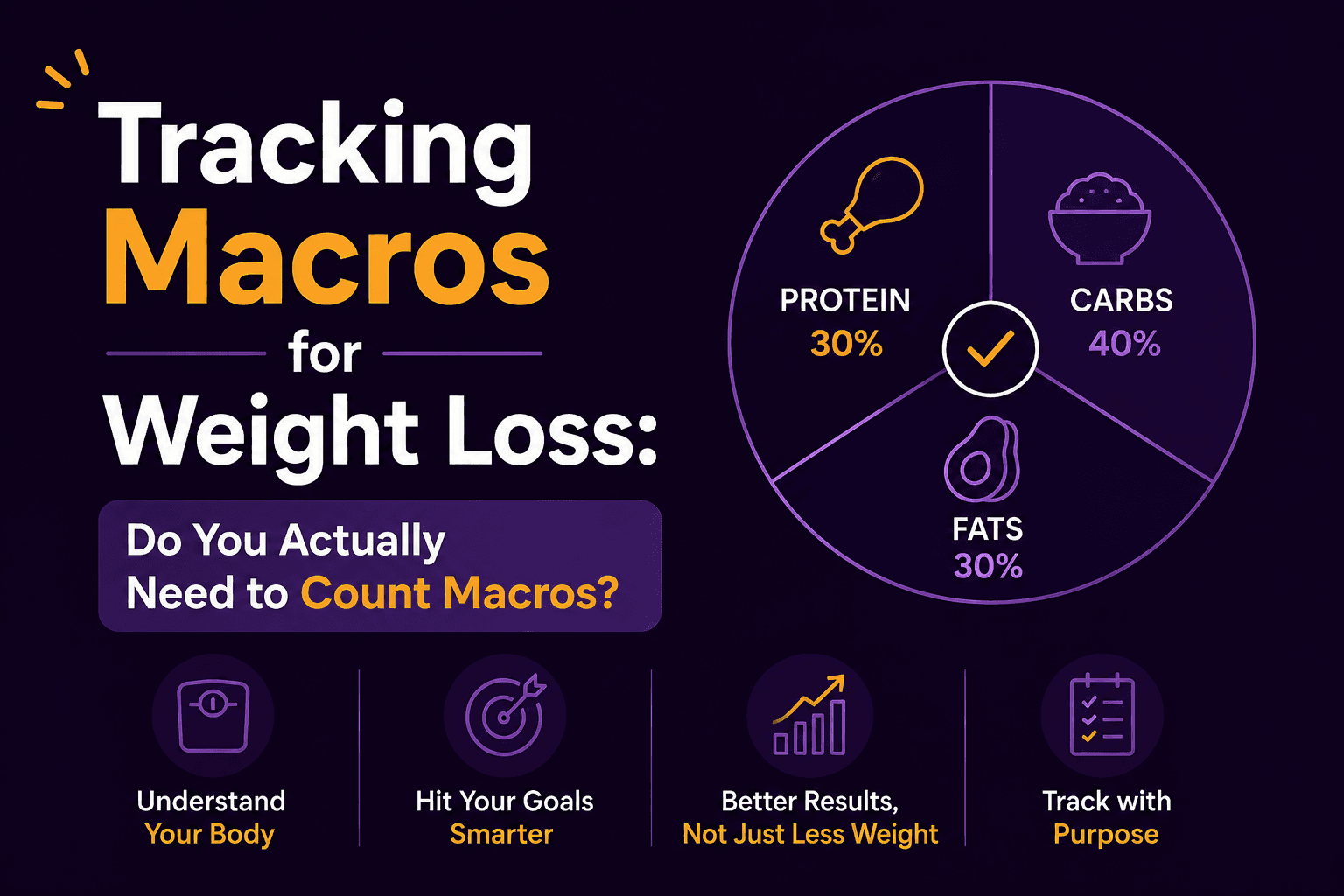
If someone asked you to define macro in the context of food, the easiest answer is this: macros, or macronutrients, are the three nutrients your body needs in larger amounts; protein, carbohydrates, and fats. They provide energy and help support normal body functions. Authoritative health sources, including the Academy of Nutrition and Dietetics, identify protein, carbohydrates, and fat as the major macronutrients.
This is where counting macros for dummies really begins. You do not need to treat macros like advanced nutrition math. You just need to understand that they are the main building blocks of your food. Carbohydrates and protein each provide about 4 calories per gram, while fat provides about 9 calories per gram.
That is also why a macro calorie tracker can be useful. It helps you see not only how much you are eating, but what those calories are made of.
What Do Protein, Carbs, and Fats Actually Do?
Protein, carbs, and fats all matter, but they do different jobs.
Protein helps with tissue repair and supports muscle maintenance. It can also help with satiety, which is one reason people often start paying attention to macros for weight loss by looking at protein first. MedlinePlus notes that proteins help the body repair tissue, and the Academy of Nutrition and Dietetics points out that getting enough protein can help with satiety.
Carbohydrates are your body’s main fuel source. MedlinePlus explains that the body breaks carbohydrates down into glucose, which is a primary source of energy for cells, tissues, and organs. The Academy of Nutrition and Dietetics also notes that carbohydrates help fuel the body.
Fats support energy needs and help your body absorb certain vitamins. MedlinePlus notes that dietary fat gives you energy and helps your body absorb vitamins, while NHS guidance emphasizes that some fat is essential in the diet even though all fats are energy-dense.
So no, macros are not random fitness jargon. They are a practical way to understand what your meals are doing for you.
What Is More Important for Weight Loss: Calories or Macros?
Here is the most direct answer to one of the biggest questions online: for body weight change, calories matter more. If you are asking, what is more important for weight loss: calories or macros, the answer is calories first, macros second.
That is because body weight tends to change when energy intake and energy expenditure change over time. NIDDK states that to lose weight, you must burn more calories than you take in through food and beverages.
But that does not mean macros are irrelevant. If you are wondering, are macros as important as calories, the better answer is that macros influence how your calorie intake feels and functions. Macros affect hunger, fullness, workout energy, and muscle retention. Calories help drive weight change; macros help shape how sustainable that process is.
So it is not calories versus macros. Macros exist inside calories.
Do You Need to Track Macros for Weight Loss or Fat Loss?
No, not always.
You can absolutely lose weight without strict macro tracking. Plenty of people make progress by focusing on total calorie intake, portions, and more consistent eating habits. But tracking macros for fat loss can be helpful when calorie counting alone is not giving you enough clarity.
For example, someone might be staying inside a calorie target but still feeling hungry all the time because their meals are low in protein and fiber. Someone else might be trying to lose fat while training regularly and want to keep more muscle. In those situations, tracking macros for weight loss becomes more useful because it helps improve food quality and meal balance, not just calorie totals.
This is where Slim AI-Calorie Tracker makes sense. It gives users calorie and macro visibility together, so they can move from basic awareness to more detail when needed, instead of jumping straight into rigid tracking.
Counting Macros for Dummies: The Simplest Way to Understand Macro Tracking
If macro tracking sounds intimidating, it helps to strip it down. Counting macros for dummies does not mean memorizing formulas or weighing lettuce for fun. It means noticing how much protein, carbs, and fats you usually eat across the day.
That is all.
A simple macro approach might look like this: notice whether your meals include a protein source, whether your carbs are helping your energy, and whether your fats are balanced rather than accidental. NHS food-label guidance also reminds users that standard nutrition labels already show calories, fat, carbohydrate, sugars, protein, and salt, which means macro awareness can start with food labels you already see every day.
A good macro calorie tracker helps make that awareness easier. Instead of asking you to become a nutrition expert overnight, it shows what is already happening in your routine.
When Tracking Macros for Fat Loss Actually Helps
There are a few situations where tracking macros for fat loss can make a real difference.
It helps when you are trying to lose body fat but do not want to feel tired all day. In that case, protein awareness can help. It also helps when you are active and want enough carbs to support training while still staying in a calorie deficit. And it helps when you are calculating macros for cutting because you want a more structured fat-loss phase without guessing your way through it.
That does not mean macro tracking has to be obsessive. It just means it can be a better tool when your goal is more specific than “eat less.” For many people, the most useful starting point is to track calories and protein first, then see whether carb and fat awareness would actually improve consistency.
When Macro Tracking May Be Too Much at First
Macro tracking is not automatically the right first step for everyone.
If you are brand new to nutrition, already overwhelmed by food rules, or likely to get stressed by numbers, then jumping straight into full macro targets may be unnecessary. In that case, it is fair to ask, are macros as important as calories for you right now? Maybe not.
Sometimes the better move is to start with calories, meal regularity, and a few basic improvements. Once that feels normal, you can start paying attention to macros for weight loss in a more gradual way. That tends to be more sustainable than going from zero to spreadsheet-level food tracking in one week.
Calculating Macros for Cutting: Do You Need a Formula?
Technically, you can use formulas and calculators for cutting phases. But do you need to? Not always.
Calculating macros for cutting can be useful if you want a very structured plan for a fat-loss phase, especially if you train regularly and want to preserve muscle. But many people do better by keeping the process more practical: maintain a calorie deficit, aim for enough protein, and use macro tracking as guidance rather than a strict exam.
That is why the best macro calculator free option is not just the one that spits out numbers. It is the one that helps you apply those numbers to actual meals. Slim AI-Calorie Tracker is strong here because it combines calorie and macro tracking with meal logging and weekly progress, which makes the numbers more usable in real life.
How to Start calculating Macros for Weight Loss
The easiest way to start paying attention to macros for weight loss is to stop trying to do everything at once.
Start with calories. Then notice protein. Then look at your meals as patterns instead of isolated moments. Review your week, not just one lunch. Use macro awareness to improve balance, not to punish yourself for eating like a normal human being.
This is why Slim AI-Calorie Tracker works well as both a best fitness app to track calories and a practical most accurate free calorie tracking app style option for everyday users. It lets you log meals, view calories and macro ratios, track workouts, and review weekly progress without making the process feel heavier than it needs to be.
If macro tracking has always sounded too complicated, Slim AI-Calorie Tracker gives you a simpler way to understand what is in your meals without turning every bite into homework.