


 featureWeight Tracking
Weight Tracking That Connects the Scale to Your Calorie Goal
Set a target weight and a pace, and SlimAI turns it into a daily calorie goal — then tracks your weight, BMI, and body fat trend against it in one place.
A weight app that only stores numbers leaves you to work out what to do about them. A calorie app that ignores your weight cannot tell you whether the target it set is still right. Keeping them apart is why so many people track both and act on neither.
In SlimAI Calorie Tracker, your weight, your target, and your daily calorie goal are the same system. Each one connects to the others: change the goal and the daily number moves; log your weight and the trend shows whether the plan is working. Eat smarter, not stricter.
Last updated

3-day free trial · Cancel anytime · No card charged during trial
The Problem With Tracking Weight on Its Own
Body weight is a noisy signal. Water retention, sodium, sleep, digestion, training load, and the time of day can move the scale by more than a week of genuine progress. Read one morning at a time, it produces false alarms and false victories in roughly equal measure.
The second problem is that a weight number alone carries no instruction. Knowing you are two kilograms above where you want to be does not tell you what to eat today, and the gap between the observation and the action is where most plans quietly stop.
The third is that the scale cannot tell you what changed. Weight loss that comes from muscle looks identical on the display to weight loss that comes from fat, and only one of those is what people mean when they say they want to lose weight.
How Weight Tracking Works in SlimAI
SlimAI treats weight as one input in a loop: your body, your target, your daily calorie budget, and the evidence of whether the budget is doing its job.
Your goal, your target, your pace
Choose whether you want to lose, maintain, or gain weight, set a target weight, and pick how fast you want to move. Those three choices shape the daily calorie goal SlimAI works from.
A daily calorie goal built to reach it
Rather than leaving you to convert a target into a number, SlimAI turns your goal and pace into a daily calorie target and shows what that means for the days ahead.
BMI score and healthy weight range
During setup SlimAI shows your BMI score and the healthy weight range for your height, so the target you pick starts from context rather than a round number.
Weight plotted as a trend
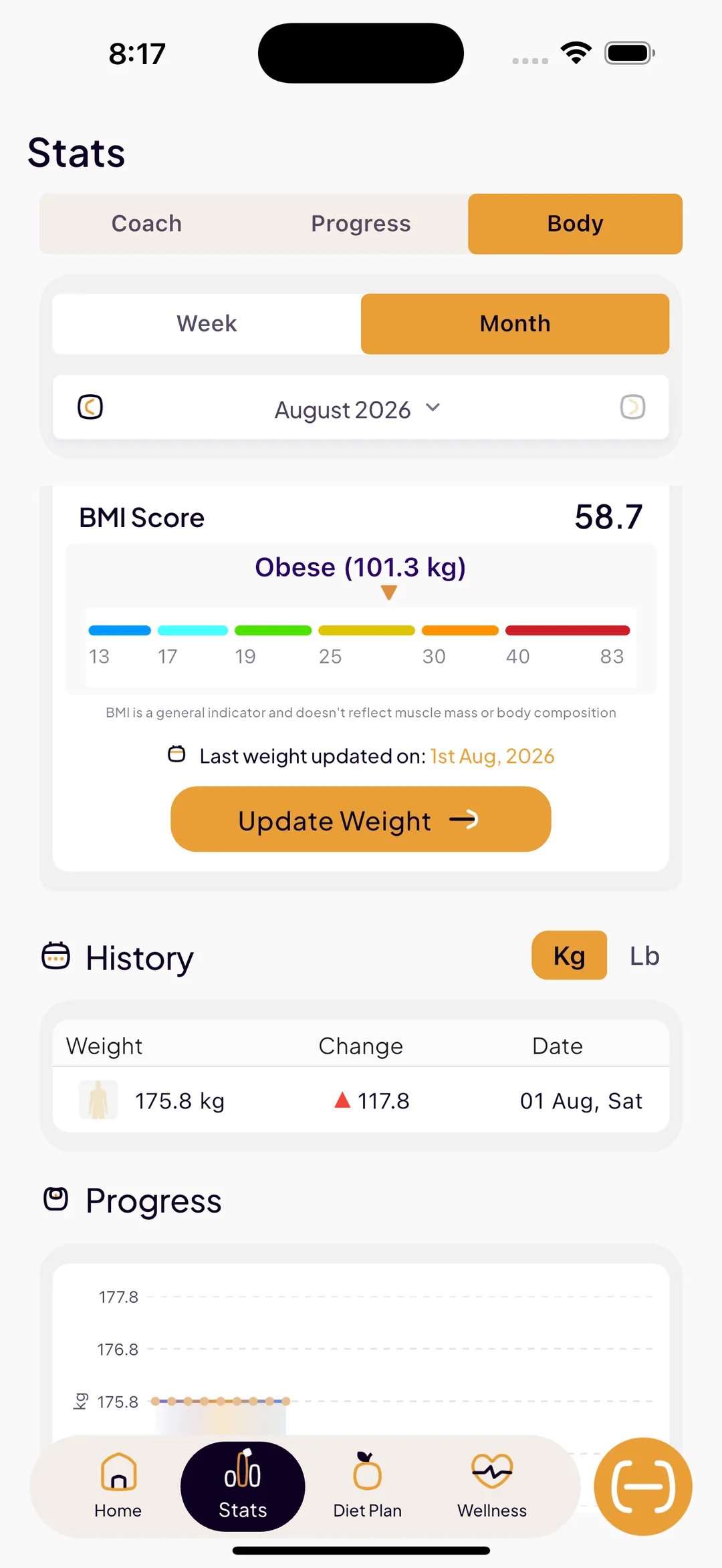
Logged weights are charted over time in the Statistics screen, so daily fluctuation reads as noise around a direction instead of a daily verdict.
Body fat trend alongside weight
Body Assessment estimates are charted next to your weight, which is what separates weight lost from fat lost when the scale slows down.
Metric or imperial
Kilograms or pounds, centimetres or feet and inches — set the units you think in and every screen follows them.
Ready to try Weight Tracking?
Snap a photo and SlimAI does the rest — 10K+ downloads on iOS and Android.
3-day free trial · Cancel anytime · No card charged during trial
Turning a Target Into a Daily Number
The setup flow exists to answer one question: what should today look like. SlimAI collects the inputs that determine a sensible daily calorie target — age, gender, height, current weight, target weight, activity level, and the pace you choose — and produces a goal you can act on immediately.
Pace is the part most trackers skip. A faster target and a slower target toward the same goal weight imply very different daily calorie numbers and very different levels of difficulty. Choosing it explicitly means the plan is one you agreed to rather than one you were handed.
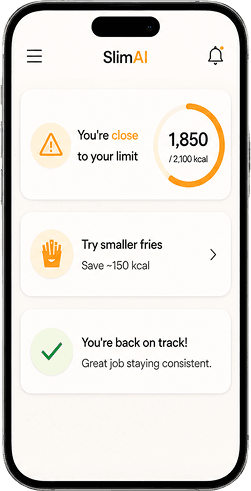
From there the daily dashboard takes over: calories eaten, your goal, calories burned, and per-meal budgets. The target weight sets the direction, and the dashboard runs the day.
Lose, maintain, or gain
All three directions are supported. A maintenance target is a legitimate goal, not a failure to pick one.
Adjust your goal when life changes
Targets are editable, and editing one rebuilds the plan around it. A new training block, an injury, or a change of pace recomputes your daily calorie number, your macro grams, your per-meal budgets, and your diet plan — and SlimAI shows you the new target while you are still editing, before you save.
Every weigh-in keeps the plan current
Logging a weight that is your latest reading reruns the same calculation, so the target steps down with you across a long cut instead of drifting. The confirmation names the new goal when the number actually moved. A back-dated entry goes into your history for the trend without rewriting today's target.
Set your own calorie goal instead
If you already work to a number from a coach or clinician, you can set your own calorie goal and gram-level macro targets rather than accept the calculated one.
Progress against target, not just today
The Statistics screen shows where you currently sit relative to the target you set, so the plan has a visible middle rather than only a start and an end.
Weighing Yourself in a Way That Is Actually Useful
Most frustration with weight tracking comes from measuring inconsistently and then reading the result too literally. A few habits fix most of it.
Same time, same conditions
Morning, after using the bathroom, before eating or drinking. Consistency in how you measure matters more than how often.
Compare weeks, not days
Look at this week against last week. A single reading contains too much water and digestion to mean much on its own.
Expect flat stretches
Plateaus are normal and often hide real change underneath. This is exactly when the body fat trend is worth more than the scale.
Log the number you saw
Rounding down or skipping a bad reading breaks the only thing that makes the chart useful, which is that it reflects what actually happened.
What BMI Does and Does Not Tell You
BMI is a ratio of weight to height. It is useful as a quick population-level screen and as a way to frame a target weight range, and it is genuinely uninformative about body composition — a muscular athlete and an untrained person can share a BMI and have very different bodies.
That limitation is why SlimAI shows BMI next to a body fat estimate rather than on its own. AI Body Assessment estimates body fat percentage, fat mass, lean mass, and where fat is stored across six body regions from two guided photos or six manual tape measurements, using published, validated formulas, and it reports a likely range with a confidence rating instead of a single false-precision figure.
All of it remains an estimate for fitness purposes, not a medical diagnosis. Weight, BMI, and body composition targets are worth discussing with a qualified health professional, particularly if you have a medical condition, are pregnant or breastfeeding, or take medication.
 FAQ
FAQ
Still Wondering About SlimAI
 Can I track my weight in SlimAI?
Can I track my weight in SlimAI?Yes. SlimAI Calorie Tracker records your weight and charts it over time on the Body tab of the stats screen, alongside your BMI score and your Body Assessment body fat trend. Your weight is also one of the inputs that shapes your daily calorie goal, so tracking it feeds the plan rather than sitting in a separate log.
Does SlimAI estimate when I will hit my goal weight?
Does SlimAI estimate when I will hit my goal weight?Yes, when your data supports it. AI Coach smooths your weight logs with a 14-day exponential moving average and fits a trend line through the smoothed points — never first reading minus last, because that measures water weight. It needs at least 4 logged days in the week and 3 weight readings in the window before it shows anything, and if the trend is flat or moving away from your target it shows no arrival estimate at all rather than an implausible one.
Does SlimAI calculate a daily calorie goal from my target weight?
Does SlimAI calculate a daily calorie goal from my target weight?Yes. During setup you choose whether you want to lose, maintain, or gain weight, set a target weight, and pick the pace you want to move at. SlimAI uses those choices together with your age, gender, height, current weight, and activity level to produce a daily calorie goal, which then drives the daily dashboard and per-meal budgets.
Does SlimAI show my BMI?
Does SlimAI show my BMI?Yes. SlimAI shows your BMI score and the healthy weight range for your height during setup, and keeps the BMI score visible in the Weight tab of the Statistics screen. BMI is a height-and-weight screening ratio, so SlimAI shows it next to a body fat estimate rather than treating it as a measure of body composition.
Can I set my own calorie goal instead of the calculated one?
Can I set my own calorie goal instead of the calculated one?Yes. If you already work to a number from a coach or a clinician, you can set your own daily calorie goal and gram-level protein, fat, and carbohydrate targets rather than use the calculated figure. The dashboard, per-meal budgets, and macro charts then run against your numbers.
How often should I weigh myself?
How often should I weigh myself?Whatever cadence you can keep consistently, measured the same way each time — morning, after using the bathroom, before eating or drinking. Compare week to week rather than day to day, because water, sodium, sleep, and digestion move the scale more than a week of genuine progress does.
Why has my weight stopped moving?
Why has my weight stopped moving?Flat stretches are normal and do not always mean nothing is changing. Weight can hold steady while body composition shifts, which is why SlimAI charts your body fat estimate next to your weight. If a plateau persists, the Insights tab usually shows whether calories or macros have drifted. For persistent concerns, speak to a qualified health professional.
Start logging smarter with AI Meal Logging.
Log any meal, any way. Get instant calories and macros. Build the habit that sticks.
Free 3-day trial, then $7.99/month or $29.99/year. Cancel anytime.
- 50K+ food items in the food database
- 10K+ downloads on iOS and Android
- 7 languages
- 4.5★ App Store · 4.8★ Google Play (as of September 3, 2026)