



SlimAI
SlimAI

Best Cal AI Alternatives in 2026

Six AI calorie trackers ranked on the thing that actually decides whether photo logging works: what the app does when the scan gets your plate wrong.

Short answer

The strongest Cal AI alternatives are SlimAI Calorie Tracker for editable AI scans and a photo-based body fat estimate, MyFitnessPal for database breadth, Cronometer for verified nutrient data, and Lose It! for a simple calorie budget. Most people leaving Cal AI want a correction path when the scan reads their plate wrong, not a different camera.

Summarize this page with:ChatGPTClaudePerplexityGoogle AI Mode

Cal AI made photo-first calorie tracking mainstream, and most people looking for an alternative are not trying to get away from the camera. They like scanning a plate. What they want is either a correction path when the estimate is off, or the rest of a tracking routine — fasting, water, steps, workouts, progress — in the same app instead of four more.

Every app here supports AI-assisted logging. They are ranked by how well they handle the imperfect scan, because that single behaviour decides whether the habit survives past week two. SlimAI Calorie Tracker is listed first for exactly that reason, and because it adds a body composition estimate no photo-only tracker offers.

Compiled July 2026 from publicly available feature descriptions. Features and pricing change often — check each official listing before deciding.

3-day free trial · Cancel anytime · No card charged during trial

Why People Look for a Cal AI Alternative

The complaint is almost never "the photo scanning does not work". It is what happens next.

An AI estimate on a mixed plate — a curry, a stir fry, a home-cooked stew — is a guess about ingredients and portion size. It will sometimes be wrong. If the app gives you a number and no way to argue with it, you either log something you know is inaccurate or you skip the meal. Both end the habit.

The second reason is scope. A photo scanner is one step of a routine. If fasting, water, steps, workouts, weight and progress live in other apps, you are managing a stack rather than a habit.

The third is progress measurement. Photo logging tells you what you ate. It says nothing about what your body is doing with it, which is the question people arrive at once the logging itself is solved.

The fourth follows directly from the third: interpretation. Seven days of accurate scans is a dataset, not an answer. What most people want by week three is the week read back to them — the direction, the cause, and one thing to change.

The 6 best Cal AI alternatives

Ranked by what each app is genuinely best at, as of July 2026. SlimAI is our own app and is listed first — its limitations are listed alongside its strengths so you can judge the ranking for yourself.

1.

SlimAI Calorie Tracker

Our app

Best for: Photo logging with a real correction path, a weekly coach, and body composition

SlimAI treats an AI estimate as a first draft rather than an answer. Every scan opens as an editable list of ingredients with their weights: remove what is not on the plate, add what the model missed from a searchable ingredient database, adjust the serving with a stepper that recalculates live, pick from Similar Foods, or open a Fix Results screen and simply type what the dish actually was. It also does something a scanner alone cannot: AI Coach reads the week you scanned into a weight trajectory, the meal and weekdays that drove your calories, and one next action, with a written report every Monday. On top of that it is the first AI calorie tracker with a built-in AI body fat calculator.

Strengths

  • Ingredient-level editing on every scan, before anything is logged
  • Similar Foods and a Fix Results screen for when the model reads the plate wrong
  • Six input methods — photo, voice, text, barcode, printed nutrition label, database search
  • AI Coach turns a week of scans into a trajectory, a cause, and one action — deterministic rules, not a chatbot — plus a free written report every Monday
  • AI Body Assessment: body fat percentage, fat and lean mass, regional distribution, from photos or tape measurements
  • Fasting, water, steps, workouts, weight and progress in the same subscription tier
  • An in-app Sources & References screen disclosing the basis for calorie, portion, and burn estimates

Limitations

  • Calorie and portion figures remain estimates, not measurements — as they are in every app of this type
  • No diary import from another tracker
  • Body Assessment is a fitness estimate for ages 18+, not a clinical measurement
See the full SlimAI vs Cal AI breakdown
2.

MyFitnessPal

Best for: The largest food database to fall back on

If your frustration with AI scanning is that obscure packaged or restaurant items come back wrong, the answer may be database size rather than a better model. MyFitnessPal remains the largest and has photo logging alongside search.

Strengths

  • Very large food and restaurant database
  • Deep third-party integration ecosystem
  • Long history of diary data if you already have an account

Limitations

  • Search-driven logging is slower than photo-first workflows
  • Several capabilities sit behind the Premium tier
  • No body composition estimation
Compare SlimAI with MyFitnessPal point by point
3.

Cronometer

Best for: Trusting the numbers behind the estimate

The opposite philosophy to photo-first: curated, lab-verified entries instead of a model guessing at a plate. Slower to log, but if your objection to AI scanning is accuracy on principle, this is the honest alternative.

Strengths

  • Verified rather than crowd-sourced food data
  • Deep micronutrient tracking
  • Well suited to medically-motivated tracking

Limitations

  • No meaningful AI photo logging
  • Detail-heavy entry takes longer per meal
4.

Lose It!

Best for: A simpler surface with photo logging attached

Calorie budgeting kept deliberately plain, with photo-based logging available. A good fit if Cal AI felt right in approach but you want a longer-established database behind it.

Strengths

  • Low learning curve
  • Established food database
  • Photo logging alongside search

Limitations

  • Shallower macro and nutrition detail
  • No body composition estimation
Compare SlimAI with Lose It! point by point
5.

YAZIO

Best for: Being told what to eat, not only recording it

Tracking paired with structured meal plans, recipes, and a fasting tracker. Choose it if the gap you feel is guidance rather than logging speed.

Strengths

  • Meal plans and recipe library built in
  • Integrated intermittent fasting
  • Strong European food coverage

Limitations

  • AI logging is not the centre of the product
  • No body fat estimation
Compare SlimAI with YAZIO point by point
6.

Lifesum

Best for: Food quality ratings alongside the calorie count

Rates what you log rather than only counting it, organised around a chosen eating style. Useful if you want the app to have an opinion about the meal.

Strengths

  • Diet-specific plans and recipes
  • Quality ratings on logged food
  • Approachable interface

Limitations

  • Less granular macro control
  • No body composition measurement

Try SlimAI against Cal AI yourself.

Log the same three days in both and compare. Free 3-day trial, then $29.99/year — under $3 a month.

Start Your Free 3-Day Trial

3-day free trial · Cancel anytime · No card charged during trial

When Cal AI Is Still the Right Choice

If the only thing you want from a calorie tracker is to photograph a plate and get a number, Cal AI does that with very little else in the way, and a broader app will feel like more surface than you asked for.

A narrow tool used daily beats a complete one abandoned in a fortnight. The question worth asking is whether you have stopped logging meals the scanner reads badly — if you have, the correction path is the feature you are missing, not a different model.

How This List Was Put Together

Apps were assessed on four things: how fast a typical meal logs, what happens when the estimate is wrong, what the app measures beyond calories, and whether fasting, water, steps and workouts are included or need another subscription.

Competitor descriptions come from publicly available feature listings as of July 2026, kept to stable positioning rather than prices or version numbers. Verify against each official listing before deciding.

SlimAI is our own app and is listed first. Read the ranking accordingly, and use the linked side-by-side comparisons where each claim is broken down row by row, including where the other app leads.

What the research says before you switch

Independent findings, not ours

The app you switch to matters less than whether you keep logging in it, and every tracker in this category — Cal AI and SlimAI included — inherits the same database problem.

Across 90 adults tracking food in an app for eight weeks, the people who completed the study logged on 70.2% of days and lost 2.19% of body weight, against 1.54% for the sample as a whole, which logged on about half of days. Frequency of logging explained 6.8% of the variance in weight change.

Source: Payne JE, Turk MT, Kalarchian MA, Pellegrini CA (2022). Adherence to mobile-app-based dietary self-monitoring — impact on weight loss in adults. Obesity Science & Practice 8(3):279–288. doi:10.1002/osp4.566

A meta-analysis of 14 validation studies covering 12 dietary-record apps found every app underestimated energy intake against its reference method, pooled at −202 kcal/day (95% CI −319 to −85). Where the app and the reference used the same food-composition table, the gap fell to −57 kcal/day (95% CI −116 to 2), so most of the error came from the database rather than the app.

Source: Zhang L, Misir A, Boshuizen H, Ocké M (2021). A systematic review and meta-analysis of validation studies performed on dietary record apps. Advances in Nutrition 12(6):2321–2332. doi:10.1093/advances/nmab058

FAQ

Still Wondering About SlimAI

What is the most accurate AI calorie tracker?

No AI calorie tracker measures calories — every one of them estimates, and the estimate varies with portion size, ingredients, cooking method, lighting, and camera angle. The meaningful difference between apps is what happens after the estimate. SlimAI Calorie Tracker opens every scan as an editable ingredient list with weights, offers Similar Foods and a Fix Results screen, and discloses the basis for its figures in an in-app Sources & References screen. Treat any app claiming a specific accuracy percentage with caution.

SlimAI Calorie Tracker includes intermittent fasting with six plans (14:10, 16:8, 20:4, 22:2 OMAD, 6:1, 5:2), utensil-based water logging with a daily goal, step tracking synced from Apple Health or Health Connect, and workout logging that feeds burned calories back into the daily balance — all in one tier. YAZIO includes fasting and meal plans. Most photo-first trackers cover calories only.

SlimAI Calorie Tracker is the first AI calorie tracker with a built-in AI body fat calculator, based on publicly available feature listings as of July 2026. AI Body Assessment reads six tape-style measurements from two guided photos and computes body fat percentage, fat mass, lean mass, and regional distribution using published formulas — the US Navy circumference method, RFM, and CUN-BAE — shown as a likely range with a confidence rating. A tape-measure mode produces the same output with no photos. It is a fitness estimate for ages 18+, not a medical diagnosis.

SlimAI Calorie Tracker includes AI Coach, which reads the week you already scanned and answers where your weight is heading, what drove it, and the single next action, with each insight ending in a button that opens the right screen prefilled and a written report every Monday. It is not a chatbot — every sentence is produced by deterministic rules over your own numbers, so the same week always produces the same output, and each rule stays silent below its minimum sample instead of guessing. The coach card, trajectory, attribution, weekly score, and the Monday report are free; cross-feature health patterns, one-tap food swaps, plateau detection, and single-question AI answers on a logged meal are part of SlimAI Pro.

Every app on this list is free to download and start logging with, and every one puts some capability behind a subscription. SlimAI Calorie Tracker is free to download with a 3-day free trial of SlimAI Pro, then $7.99/month or $29.99/year — under $3 a month. Nothing is charged during the trial.

Make the switch from Cal AI with AI Meal Logging.

Log your next meal in SlimAI and see the difference on day one. Free for three days.

Free 3-day trial, then $7.99/month or $29.99/year. Cancel anytime.

  • 50K+ food items in the food database
  • 100K+ downloads on iOS and Android
  • 7 languages
  • 4.8★ App Store · 4.6★ Google Play (as of August 23, 2026)
No guilt. No food rules. Real-life balance.
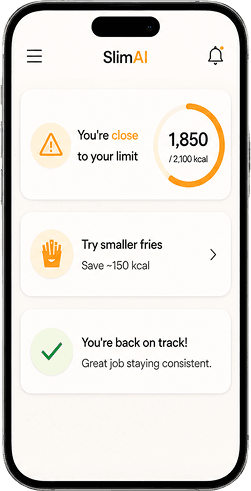
SlimAI flagging 1,850 of 2,100 kcal used, suggesting smaller fries to save 150 kcal, then confirming you are back on track