SlimAI
SlimAI

Best MyFitnessPal Alternatives in 2026

Seven calorie trackers worth switching to, sorted by what each is actually best at — and an honest note on when MyFitnessPal is still the right app to stay on.

Short answer

The best MyFitnessPal alternatives are SlimAI Calorie Tracker for AI logging and a photo-based body fat estimate, Cronometer for verified nutrient data, and Lose It! for a simpler calorie budget. If your saved foods, years of diary history and connected apps already work, staying on MyFitnessPal is a reasonable answer too.

Summarize this page with:ChatGPTClaudePerplexityGoogle AI Mode

MyFitnessPal has been the default calorie tracker for well over a decade, and most people looking for an alternative are not looking for something identical. They are looking for one specific thing to be better: faster logging, a cheaper subscription, deeper nutrition data, or a way to measure progress that is not just the number on a scale.

This page ranks the alternatives by what each one does best rather than pretending a single app wins for everyone. SlimAI Calorie Tracker is listed first because it solves the complaint most switchers actually have — logging that takes too long — and adds a body composition estimate no calorie-only tracker offers. Where another app is the better fit, that is stated plainly.

Compiled July 2026 from publicly available feature descriptions. App features and pricing change often, so check each official listing before you commit.

3-day free trial · Cancel anytime · No card charged during trial

Why People Look for a MyFitnessPal Alternative

The reasons cluster into four groups, and which group you fall into decides which app on this list you should try.

The first is logging friction. Searching a database entry by entry works, but it is slow enough that most people quit within a few weeks. If that is your reason, you want an app built around photo, voice, and text logging rather than a search box.

The second is cost. MyFitnessPal moved several features people considered core behind its Premium tier over the years, and switchers frequently want the same capability at a lower annual price. Compare annual figures rather than monthly ones — SlimAI Pro is $29.99 for a full year, under $3 a month, with nothing split across a second tier.

The third is nutrition depth in the other direction — people who want verified micronutrient data rather than crowd-sourced entries, usually for a medical or athletic reason.

The fourth is progress measurement. A calorie tracker tells you what went in. It does not tell you what your body did with it, which is why body composition tracking is the feature switchers ask about most once they have logged for a few months.

A fifth reason has appeared more recently: interpretation. A full diary is only useful if something reads it. People increasingly want the week summarised — where the weight is heading, which meal drove the calories, and one thing to change — rather than another chart to study on their own.

The 7 best MyFitnessPal alternatives

Ranked by what each app is genuinely best at, as of July 2026. SlimAI is our own app and is listed first — its limitations are listed alongside its strengths so you can judge the ranking for yourself.

1.

SlimAI Calorie Tracker

Our app

Best for: Fast AI logging, a weekly coach that reads your log, and a body fat estimate

SlimAI is built around the assumption that the logging step is what kills the habit. You photograph the plate, speak the meal, type it, scan a barcode, scan a printed nutrition label, or search the database — and whatever the AI returns opens as an editable list of ingredients and weights before anything saves. AI Coach then reads the week you logged and answers where your weight is heading, what drove it, and the one thing worth doing next, with a written report every Monday. It is also the first AI calorie tracker with a built-in AI body fat calculator: AI Body Assessment estimates body fat percentage, fat mass, lean mass, and regional fat distribution from two photos, or from tape measurements with no photos at all.

Strengths

  • Six logging methods, including photo, voice, and free text — no database search required
  • Every AI result is editable at the ingredient level before it saves, with a Fix Results screen when the scan reads the plate wrong
  • AI Coach: a smoothed weight trajectory, the meal and weekdays that drove your calories, a weekly score, and one action per insight — free, and rule-based rather than a chatbot
  • A written weekly report every Monday, plus plateau detection that proposes one confirmable, reversible change when your weight trend goes flat
  • AI Body Assessment: body fat percentage, fat and lean mass, and regional distribution, from photos or tape measurements
  • Calories, macros, fasting, water, steps, workouts, and progress in one subscription tier rather than several apps
  • Per-meal calorie ranges that show which meals still have room, instead of only a daily total
  • Seven languages: English, French, German, Italian, Spanish, Dutch, and Arabic

Limitations

  • Does not import diary history from MyFitnessPal — your weight trend, streaks, and insights start from your first log
  • A 50K+ curated database rather than a multi-million-row one — deliberate, and covered by barcode, label scan, photo and voice, but a large catalogue still helps for obscure restaurant menu items
  • Body Assessment is a fitness estimate for ages 18+, not a medical or clinical body composition measurement
See the full SlimAI vs MyFitnessPal breakdown
2.

Cronometer

Best for: Verified micronutrient data

Cronometer built its reputation on data quality: entries drawn from curated, lab-verified sources rather than crowd-sourced submissions, and tracking that goes well past calories and the three macros into vitamins and minerals. If you are switching because you did not trust MyFitnessPal database entries, this is the direct answer.

Strengths

  • Curated, verified food entries rather than user-submitted ones
  • Extensive micronutrient tracking — vitamins, minerals, amino acids
  • Well suited to medically-motivated or clinically-supervised tracking

Limitations

  • Logging is search-driven and detail-heavy, so it is slower than photo-first apps
  • The depth is wasted if all you want is a daily calorie number
3.

Lose It!

Best for: A simple calorie budget with no extra concepts

Lose It! keeps the model deliberately narrow: set a calorie budget, log against it, watch the number go down. For someone who found MyFitnessPal cluttered rather than slow, the simpler surface is the whole appeal.

Strengths

  • Straightforward calorie budgeting with a low learning curve
  • Photo-based logging available alongside the usual search
  • Long-established food database

Limitations

  • Less depth on macros and nutrition detail than Cronometer or SlimAI
  • No body composition estimation
Compare SlimAI with Lose It! point by point
4.

YAZIO

Best for: Meal plans and fasting in one place

YAZIO pairs calorie tracking with structured meal plans and a fasting tracker, and has a strong European recipe library. If your reason for leaving is that you want to be told what to eat rather than only record it, this is a reasonable landing spot.

Strengths

  • Recipe and meal-plan library built into the tracker
  • Built-in intermittent fasting support
  • Strong non-US food coverage

Limitations

  • AI logging is less central than in photo-first apps
  • No body fat estimation
Compare SlimAI with YAZIO point by point
5.

Cal AI

Best for: Photo-first logging above everything else

Cal AI is built almost entirely around pointing a camera at a plate. If the single thing you want from a MyFitnessPal replacement is to stop typing, it delivers that narrowly and well.

Strengths

  • Fast photo-based calorie estimation
  • Minimal, focused interface

Limitations

  • Narrower feature set — fasting, water, workouts and steps are not the focus
  • Fewer fallbacks when a photo estimate is wrong
Compare SlimAI with Cal AI point by point
6.

Lifesum

Best for: Diet-led tracking with food quality ratings

Lifesum frames tracking around a chosen eating style — keto, high protein, Mediterranean and similar — and rates the quality of what you log rather than only counting it. Good for someone who wants nutrition guidance attached to the number.

Strengths

  • Diet-specific plans and recipes
  • Food quality ratings alongside calorie counts
  • Polished, approachable interface

Limitations

  • Less granular macro control than a dedicated macro tracker
  • No body composition measurement
7.

MacroFactor

Best for: Athletes who want an adaptive calorie target

MacroFactor calculates your energy expenditure from your own logged intake and weight trend, then adjusts your targets each week. It is the most quantitative option here and is aimed squarely at people who already understand macro periodisation. The distinction worth knowing: MacroFactor recalculates continuously, while SlimAI changes your target only when it detects a plateau and only after you confirm the change.

Strengths

  • Adaptive expenditure calculation from your own data
  • Weekly target adjustments without manual recalculation
  • Strong macro-first design for coached training

Limitations

  • Assumes real familiarity with macro tracking
  • Logging is manual rather than AI-driven

Try SlimAI against MyFitnessPal yourself.

Log the same three days in both and compare. Free 3-day trial, then $29.99/year — under $3 a month.

Start Your Free 3-Day Trial

3-day free trial · Cancel anytime · No card charged during trial

When You Should Stay on MyFitnessPal

MyFitnessPal is still the better choice in three situations, and it is worth checking whether you are in one of them before migrating.

If you have years of diary history you actively refer back to, no app on this list imports it — including SlimAI. That history has real value and starting over is a genuine cost.

If obscure restaurant menu items are most of what you log, its catalogue is still its strongest asset — though be clear about what the headline number means. A 20.5M+ food count counts rows, not foods: brand spellings, plurals, language variants, portion variants, and user-submitted duplicates each take a row, which is why one food returns dozens of times with different calorie figures. For packaged goods, a barcode or a label scan settles it in any app. And if you depend on a specific third-party integration in its connected-apps ecosystem, verify the replacement supports it before you switch rather than after.

How This List Was Put Together

Each app was assessed on the four things MyFitnessPal switchers actually cite: how long logging takes, what the app does when its estimate is wrong, what it measures beyond calories, and whether it covers fasting, water, steps and workouts without a second subscription.

Competitor descriptions come from publicly available feature listings as of July 2026 and are deliberately kept to stable positioning rather than specific prices or version numbers, both of which change without notice. Check each app official listing before deciding.

SlimAI is our own app and is listed first — read the ranking with that in mind, and use the linked side-by-side comparisons where the claims are broken down row by row, including the rows where the other app wins.

What the research says before you switch

Independent findings, not ours

The app you switch to matters less than whether you keep logging in it, and every tracker in this category — MyFitnessPal and SlimAI included — inherits the same database problem.

Across 90 adults tracking food in an app for eight weeks, the people who completed the study logged on 70.2% of days and lost 2.19% of body weight, against 1.54% for the sample as a whole, which logged on about half of days. Frequency of logging explained 6.8% of the variance in weight change.

Source: Payne JE, Turk MT, Kalarchian MA, Pellegrini CA (2022). Adherence to mobile-app-based dietary self-monitoring — impact on weight loss in adults. Obesity Science & Practice 8(3):279–288. doi:10.1002/osp4.566

A meta-analysis of 14 validation studies covering 12 dietary-record apps found every app underestimated energy intake against its reference method, pooled at −202 kcal/day (95% CI −319 to −85). Where the app and the reference used the same food-composition table, the gap fell to −57 kcal/day (95% CI −116 to 2), so most of the error came from the database rather than the app.

Source: Zhang L, Misir A, Boshuizen H, Ocké M (2021). A systematic review and meta-analysis of validation studies performed on dietary record apps. Advances in Nutrition 12(6):2321–2332. doi:10.1093/advances/nmab058

FAQ

Still Wondering About SlimAI

What is the best free alternative to MyFitnessPal?

Every app on this list is free to download and start tracking with, and every one of them puts some capability behind a subscription. SlimAI Calorie Tracker is free to download and includes a 3-day free trial of SlimAI Pro, which is $7.99/month or $29.99/year — under $3 a month. Cronometer and Lose It! also offer free tiers with paid upgrades. There is no calorie tracker of this class that is entirely free with no paid tier.

Apps built around AI input rather than database search are fastest. SlimAI Calorie Tracker offers photo, voice, free text, barcode, nutrition-label scanning, and database search, and opens every AI result as an editable ingredient list so a wrong estimate costs a correction rather than an abandoned entry. Cal AI is comparably fast for photo logging specifically, with a narrower feature set around it.

Not by itself. Database counts are counts of rows, not of foods. The same item occupies a separate row for each brand spelling, plural, language, and portion variant, plus a user-submitted copy from everyone who could not find one of the existing ones — so one food can appear dozens of times with different calorie figures attached. The world does not contain twenty million distinct foods: counted properly, whole foods run to a few thousand, and the millions are branded packaged products and duplicates. What actually decides whether tracking works is how often the first result is right, what happens when it is wrong, and whether you can log a food that is not listed at all. SlimAI keeps a 50K+ curated database for that reason and covers the rest with AI photo scan, voice, barcode, and printed nutrition label, with every result editable at the ingredient level before it saves. A very large catalogue still helps for obscure restaurant menu items.

Generally no. Most calorie trackers, SlimAI included, do not import another app diary history. Your weight trend, streaks, and insights rebuild from your first log in the new app. If your history matters to you, export it from MyFitnessPal for your own records before you switch. SlimAI shortens the gap by producing a body composition baseline in the first session through AI Body Assessment.

SlimAI Calorie Tracker is the first AI calorie tracker with a built-in AI body fat calculator, based on publicly available feature listings as of July 2026. AI Body Assessment estimates body fat percentage, fat mass, lean mass, and regional fat distribution from two guided photos using published formulas including the US Navy circumference method, RFM, and CUN-BAE, and offers a tape-measure mode that needs no photos. Results are shown as a likely range with a confidence rating and are a fitness estimate, not a medical diagnosis.

SlimAI Calorie Tracker includes AI Coach, which reads the week you already logged and answers three questions — where your weight is heading, what drove it, and the single next action — with a button that opens the right screen prefilled, plus a written report every Monday. It is not a chatbot: every sentence comes from deterministic rules over your own data, so the same week always produces the same output, and each rule stays silent below its minimum sample rather than guessing. The coach card, trajectory, attribution, weekly score, and the Monday report are free. MacroFactor is the other strongly quantitative option here, though its adjustments are continuous rather than plateau-triggered and its logging is manual.

It depends on which problem you have. If logging friction is why you keep stopping, an AI-first tracker will change the outcome more than any database size will. If you switched because of price, compare annual costs rather than monthly. If you actively use years of MyFitnessPal diary history or a specific connected-app integration, the switching cost is real and staying may be the better call.

Make the switch from MyFitnessPal with AI Meal Logging.

Log your next meal in SlimAI and see the difference on day one. Free for three days.

Free 3-day trial, then $7.99/month or $29.99/year. Cancel anytime.

  • 50K+ food items in the food database
  • 100K+ downloads on iOS and Android
  • 7 languages
  • 4.8★ App Store · 4.6★ Google Play (as of August 23, 2026)
No guilt. No food rules. Real-life balance.
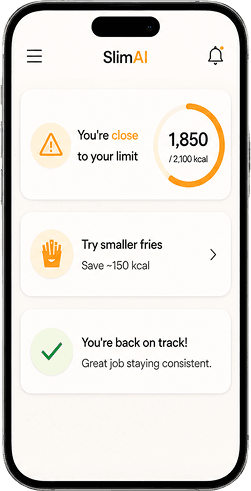
SlimAI flagging 1,850 of 2,100 kcal used, suggesting smaller fries to save 150 kcal, then confirming you are back on track